
connect@dynoviasolutions.com | +91 9231057496

From Water Treatment to Process Optimisation:
From Water Treatment to Process Optimisation: A 3-Day Learning Journey at MCPI, Haldia
How a technical programme evolved from understanding water-treatment technologies to applying Six Sigma thinking for operational excellence
Industrial water management is no longer only about treating water. For manufacturing organisations, the bigger challenge is to continuously improve process efficiency, equipment performance, resource utilisation and sustainability—while solving problems using the data generated every day on the plant floor.
This theme came alive during a three-day learning programme at MCPI Pvt Ltd, Haldia, bringing together technical perspectives on water treatment with the principles of Six Sigma, Lean thinking and operational problem-solving.
The programme was conducted by the Academy of Water Technology & Environment Management, with the third day on Six Sigma Process Optimisation and Operational Troubleshooting delivered by Dynovia Solutions LLP.
Three Days. Two Perspectives. One Objective — Better Operational Performance.
The first two days focused extensively on water-treatment technologies and their applications.
The deliberations covered the Water Treatment Process and the Present Scenario, followed by Ion Exchange Processes, Mixed Bed systems and Filtration Technologies. The participants also explored Membrane Technology and its applications through UF-RO systems.
The second day moved further into plant utilities and sustainability, covering:
- Utility Cooling Water Treatment and Efficiency
- Wastewater Treatment Scenario
- Regulatory Trends
- Technology Aspects
- Advanced Treatment for Recycle and Reuse
- Water Accounting
- Water Conservation Practices aligned with sustainability goals
This created an important technical backdrop for the third day: how can the same operational environment be looked at through a structured problem-solving and continuous-improvement lens?
That was the focus of the Six Sigma session conducted by Dynovia.
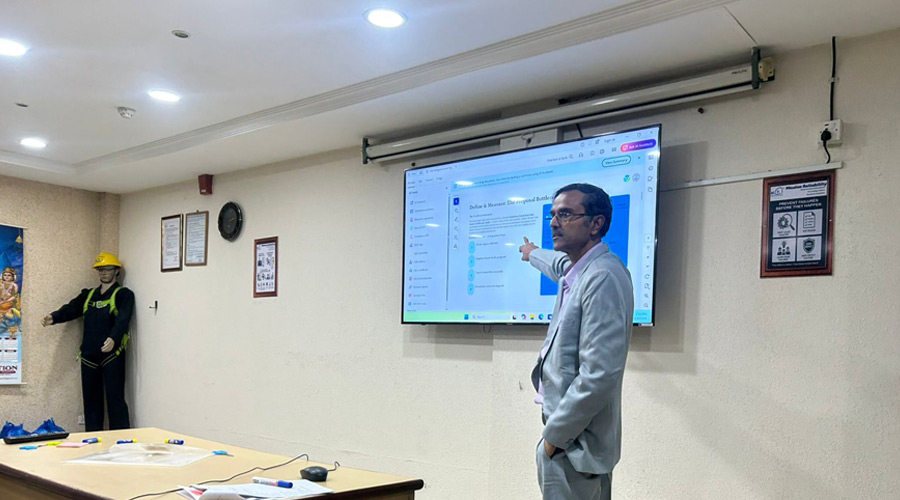
Day 3: Moving from Problem Identification to Structured Problem Solving
The third day, held on 3 September 2026, was designed around Six Sigma, Lean and Process Optimisation. The programme schedule included structured problem solving using Six Sigma methodology, continuous-improvement mindset using Lean principles, risk mitigation, higher efficiency using the same resources, lesson-learning exercises and group activities.
The day began with an introductory session by Rajkumar Mitra, Partner, Dynovia Solutions LLP setting the context for Six Sigma and the importance of approaching operational problems systematically rather than relying only on experience or intuition.
A film explaining the DMAIC methodology was then used to introduce the participants to the structured Six Sigma approach.
Define → Measure → Analyse → Improve → Control
Rather than keeping DMAIC as a theoretical framework, Priya Agarwal took the participants through its practical application.
When the Classroom Became a Problem-Solving Room
One of the strongest aspects of the session was its interactive nature.
The ten participants from the Engineering Utility Department at MCPI were encouraged to bring forward challenges they encounter in their real working environment.
Instead of simply presenting a solution, Priya used these situations to help the participants navigate the different stages of DMAIC.
The discussion demonstrated an important principle of Six Sigma:
A problem becomes easier to solve when it is converted from an assumption into a measurable problem statement.
The participants were encouraged to think about the problem, identify what should be measured, understand possible causes, develop improvement approaches and consider how the improvement could subsequently be controlled.
This transformed the session from a conventional lecture into an interactive problem-solving exercise.
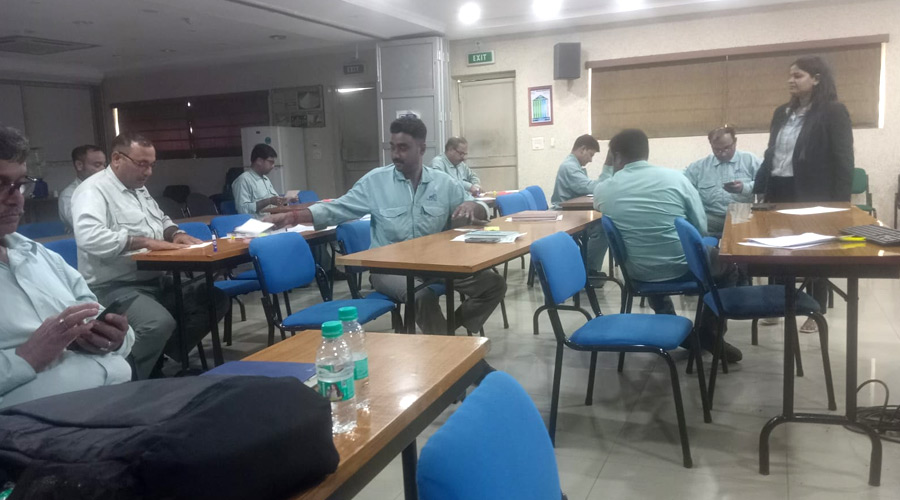
From Theory to a Manufacturing Floor — Through a Role Play
The post-lunch session added another dimension to the learning experience.
Priya conducted an engaging manufacturing-process role play involving the production of paper envelopes.
Participants became different stakeholders in the production process, while one participant played the role of the consumer, who had the authority to accept or reject the finished product.
Suddenly, concepts such as process variation, quality, customer expectations, defects and process performance were no longer abstract Six Sigma terminology.
They became part of a simulated manufacturing environment.
The exercise created a simple but powerful learning experience: quality is not determined only by what the producer believes has been manufactured correctly; it is ultimately judged against defined requirements and customer expectations.
The activity also brought out the importance of teamwork and understanding the process as a whole rather than looking at individual activities in isolation.
Learning from Real-World Cases
The interactive activities were followed by three real-life experience-based case studies shared by Rajkumar Mitra.
The objective was to connect the principles discussed during the day with situations that professionals encounter in actual industrial environments.
The combination of:
Concept → Participant Problem → Simulation → Case Study
helped create multiple perspectives on the same Six Sigma philosophy.
And Then Came the Quiz!
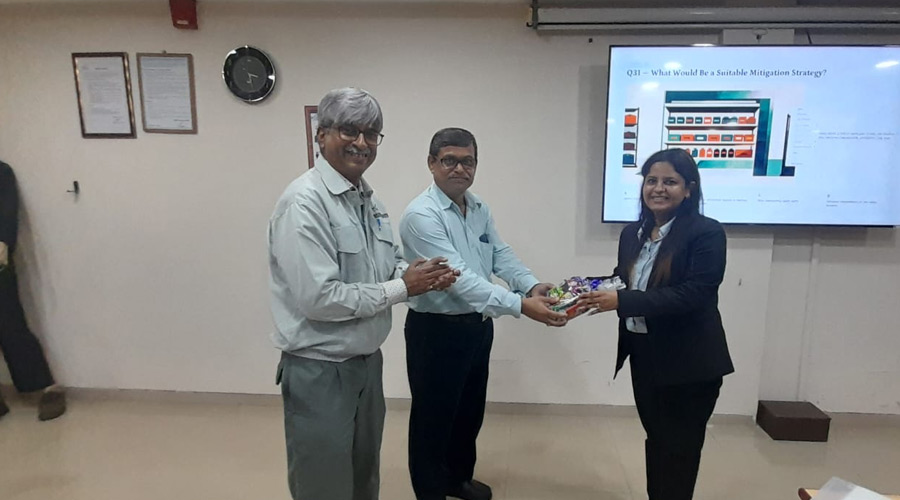
If there was one activity that particularly energised the room, it was the quiz.
The quiz created an element of excitement and competitiveness while reinforcing the concepts covered during the programme.
It was not simply a test of memory. The interactive format encouraged participants to think about the concepts discussed during the sessions and apply them to situations presented to them.
The feedback from the participants reflected this engagement.
What Did the Participants Say?
The formal feedback from the ten participants was particularly encouraging.
The workshop received an overall rating of 90%, with participants giving strong scores across the different dimensions of the programme.
Some of the strongest responses were:
- 96% — Participants felt they would be able to apply what they learned.
- 92% — Participants gained knowledge applicable to their work.
- 90% — The session delivered the information expected.
- 88% — Trainers were recognised for articulation and domain knowledge.
- 86% — Content was presented effectively.
- 82% — Participants rated the session flow and duration positively.
These numbers provide a useful indication of the programme’s effectiveness—but perhaps more importantly, the qualitative feedback pointed towards what should come next.
From Six Sigma Thinking to Six Sigma on Plant Data
Dr. Ashim Kr Bhattacharya, Founder, Academy of Water Technology & Environment Management, appreciated the interactive nature of the programme, particularly the quiz component.
At the same time, he highlighted an important opportunity for taking the learning deeper.
Since the participants came predominantly from an Engineering background, the expectation was to go beyond the management thought process and real-life examples towards equipment-performance-based Six Sigma applications.
The suggested areas included:
- Heat Exchanger / Condenser performance
- Cooling Water Efficiency
- Wastewater Treatment Efficiency
- Numerical problem solving
- Case studies based on actual plant data
- Using data generated from the system on a day-to-day basis at plant level
This feedback is significant because it points towards the natural evolution of the programme.
The first level is understanding how Six Sigma works.
The next level is learning how to use Six Sigma on the plant’s own data to improve equipment and process performance.
The Next Step: Part II — Advanced Application Workshop
Based on this feedback, Dynovia Solutions LLP proposed a specialised:
Part II / Advanced Application Workshop
Equipment Performance Optimisation & Numerical Problem Solving
The proposed programme would move the participants deeper into the application of Six Sigma by working with actual operating data and equipment-performance parameters.
The emphasis would be on converting Six Sigma from a conceptual methodology into a plant-level operational improvement tool.
The potential learning approach would revolve around questions such as:
What is the current performance?
↓
What does the plant data tell us?
↓
Where is the variation?
↓
What are the statistically significant causes?
↓
What improvement can be demonstrated numerically?
↓
How do we sustain the improvement?
This would create a natural bridge between engineering expertise and Six Sigma methodology.
Beyond Training — Building a Culture of Data-Based Improvement
The MCPI programme demonstrated that Six Sigma can be much more than a classroom methodology.
For engineering and utility professionals, its real value emerges when the methodology is applied to the equipment, processes and data that they work with every day.
The experience at MCPI also reinforced an important philosophy:
Operational excellence happens when technical knowledge, structured problem solving and data-driven decision-making come together.
The three-day programme therefore became more than a series of training sessions.
It created a progression—from understanding water-treatment technologies and sustainability, to understanding Six Sigma and Lean thinking, and finally towards the possibility of applying these methodologies to actual plant-level equipment and process performance.
And perhaps that is where the real opportunity lies.
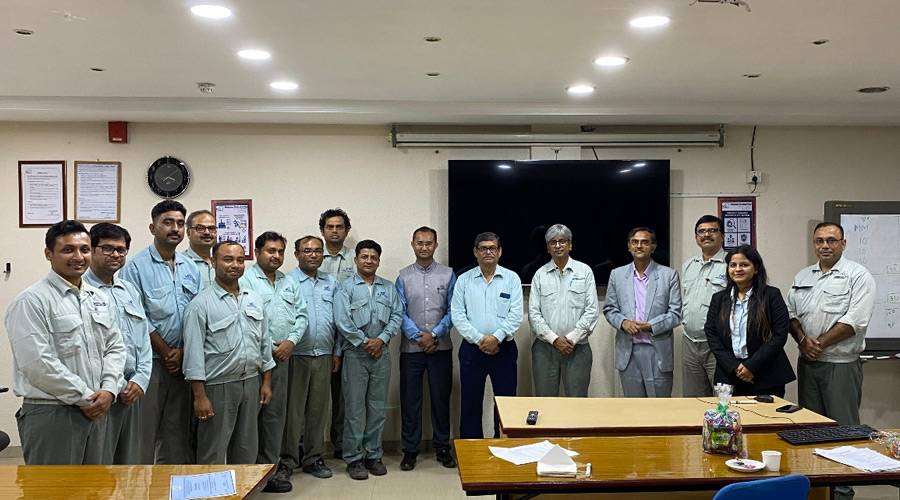
The next Six Sigma journey need not begin with a classroom case study. It can begin with a real problem, real plant data and a real opportunity for measurable improvement.
About the Programme Partners
The programme was conducted by the Academy of Water Technology & Environment Management, with Dynovia Solutions LLP delivering the Day 3 module on Six Sigma Process Optimisation and Operational Troubleshooting.
The Day 3 programme was conducted at the MCPI Haldia Plant Training Centre on 3 September 2026, with ten participants from the Engineering Utility Department.